Blockchain × AI Inference:
Sovereign, Verifiable, Autonomous
On-chain verification, smart contract AI agents, and immutable compliance trails — built on sovereign RISC-V infrastructure with no US legal nexus.

Executive Summary
Blockchain isn't just for crypto. When combined with sovereign AI inference infrastructure, it creates a fundamentally new compute paradigm — one where every inference is verifiable, every AI agent can transact autonomously, and every compliance obligation is met on-chain without human intervention.
Three capabilities unlock this paradigm:
On-chain cryptographic proof that your model ran unmodified, on specific hardware, in a known jurisdiction. No trust required.
Smart contracts that let AI agents pay for inference, settle multi-agent transactions, and hardware procurement funds — without human approval loops.
Every inference logged on-chain for EU AI Act Article 26, GDPR Article 30, and NIS2 incident documentation. Auditors verify the chain, not your spreadsheet.
AGICY integrates SUI, Ethereum, and SKALE into a three-layer blockchain architecture purpose-built for enterprise AI inference on Tenstorrent Galaxy Blackhole RISC-V hardware — all EU-sovereign, all outside CLOUD Act reach.
The Problem: Why AI Inference Needs Blockchain
Today's AI inference is a black box. Enterprises pipe sensitive data into APIs and receive outputs with zero cryptographic guarantee about what happened in between.
No enterprise can currently prove:
- Which model version ran.Was it the audited v2.3.1 or an undisclosed hotfix? Hyperscalers don't expose model weight hashes to deployers.
- Whether data was accessed by third parties. The CLOUD Act compels US-nexus providers to disclose data on demand — including data stored in EU data centres.
- That inference happened in a specific jurisdiction. Cloud providers route traffic dynamically. Your "EU region" instance may have been load-balanced to Virginia.
- That no prompt/response data was retained. Model providers routinely log inputs for fine-tuning. You agreed to it in paragraph 47 of the Terms of Service.
“If you can't verify it on-chain, you can't prove it to a regulator. And if you can't prove it to a regulator, you don't have compliance — you have a narrative.”
Blockchain provides the missing verification layer. Not as a gimmick, but as the only technology that offers tamper-proof, publicly auditable, jurisdiction-stamped records of compute events — without requiring trust in the infrastructure operator.
Three Pillars of Blockchain-Verified AI
Pillar 1 — Verifiable Inference
Every inference on AGICY generates an on-chain attestation: a cryptographic record proving that model X ran on server Y in jurisdiction Z. This is not a log file. It is an immutable, publicly verifiable proof anchored to the SUI blockchain.
The attestation includes:
- Model weight hash — SHA-256 of the exact model weights loaded at inference time. Any modification to the model invalidates the hash.
- Input/output commitment — A Pedersen commitment of the prompt and response, allowing the deployer to prove what was computed without revealing the data.
- Hardware attestation — Tenstorrent Galaxy Blackhole silicon-level attestation proving the physical server that executed the workload.
- Jurisdiction proof — GPS-stamped, network-verified location of the physical rack in Cyprus (EU Member State).
For regulated industries, AGICY supports ZK-SNARK proofs that verify inference correctness without exposing the input data. A bank can prove it ran a compliant credit-scoring model without revealing customer financial records.
Pillar 2 — Smart Contract AI Agents
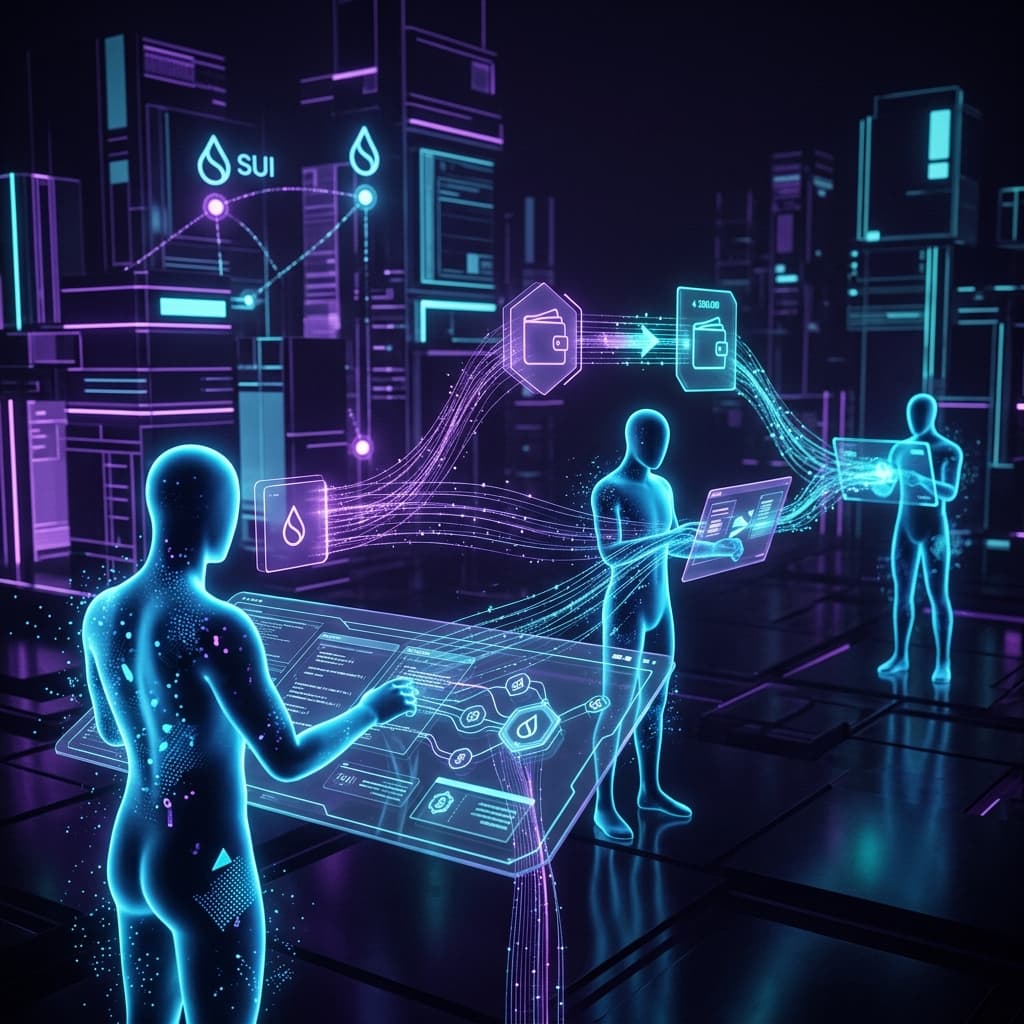
The agentic era demands that AI agents transact autonomously. AGICY's SUI integration enables agents to execute smart contracts without human intermediaries:
- Pay for compute per-query (s402 protocol). AI agents present SUI-based payment proofs with each API request. No API keys, no invoices, no billing disputes.
- Settle multi-agent transactions.When Agent A calls Agent B which calls Agent C, the entire payment chain settles atomically on SUI. No partial failures, no double-spending.
- Hardware Procurement funds for inference batches. An enterprise can lock funds in a smart contract that releases payment only when a verified inference batch completes successfully.
SUI is a launch partner for Google's Agent Payments Protocol — the emerging standard for AI-to-AI commerce. AGICY's SUI-native infrastructure means enterprises deploying on AGICY are AP2-ready from day one.
Pillar 3 — Immutable Compliance Trails
Every inference on AGICY creates an on-chain audit record that satisfies multiple EU regulatory frameworks simultaneously:
- EU AI Act Article 26 — Deployer Obligations. High-risk AI system deployers must maintain logs of system operation. AGICY logs every inference event — model version, timestamp, jurisdiction, hardware ID — directly to SUI. Deployers don't manage audit logs; the blockchain is the audit log.
- GDPR Article 30 — Records of Processing. On-chain metadata records (PII-free) document every processing activity: data categories, purposes, retention periods, and legal bases. Personal data never touches the chain; only structural metadata does.
- NIS2 — Incident Documentation. Real-time on-chain event logging captures security incidents, access anomalies, and infrastructure events. Incident timelines are reconstructed from tamper-proof on-chain data, not from potentially compromised server logs.
- DORA — Digital Operational Resilience. Financial entities can demonstrate ICT risk management and third-party monitoring using on-chain operational records, satisfying DORA Articles 5–16 without separate reporting infrastructure.
“Compliance-by-architecture is not a marketing phrase. It is the only way to scale AI deployment under four overlapping EU regulatory frameworks without hiring an army of compliance analysts.”
AGICY's Three-Layer Blockchain Architecture
AGICY doesn't bet on a single chain. Each blockchain layer is purpose-selected for what it does best, creating a composable stack that enterprise architects can reason about.
This architecture means an enterprise can deploy a compliance-critical AI workload on AGICY and get: SUI-verified inference trails, Ethereum-settled compute token economics, and SKALE-powered agent orchestration — all on one platform, all EU-sovereign.
The IP Box Advantage: 3% Effective Tax on AI IP
Cyprus offers one of the lowest IP tax rates in the European Union through its IP Box regime. Qualifying intellectual property income — including income from AI models, algorithms, and software — is taxed at an effective rate of just 2.5–3%.
Effective tax rate on qualifying AI IP income under the Cyprus IP Box regime. Compare: Ireland 6.25%, Netherlands 9%, France 10%, Germany 30%+.
When enterprises build custom models on AGICY infrastructure and register the resulting IP in Cyprus, they unlock this rate automatically. The training runs on RISC-V hardware in Cyprus. The data stays in Cyprus. The IP is created in Cyprus. The nexus is clean and defensible.
This isn't aggressive tax planning — it's the intended purpose of the Cyprus IP Box, which is fully OECD BEPS-compliant and approved by the European Commission. AGICY simply makes it operationally trivial to qualify.
“Most enterprises don't realize that where you train your model determines where you can register the IP. Train on a US hyperscaler, and the IP nexus is ambiguous. Train on AGICY in Cyprus, and it's clear.”
Deploy Any Open Source Model → Own Your IP
AGICY is model-agnostic. The AGIOS API supports any open source foundation model — Llama, Mistral, Qwen, Falcon, DeepSeek, or any custom architecture your team brings.
The workflow:
- Deployany open source foundation model on AGICY's Tenstorrent Galaxy Blackhole infrastructure via the AGIOS API.
- Fine-tune on your proprietary data. The resulting fine-tuned model is new IP — a derivative work with novel learned parameters.
- Registerthe IP in Cyprus. Because training occurred on AGICY's physical infrastructure in Cyprus, the IP nexus is geographically anchored to an EU Member State.
- Monetize at 3% effective tax. License the model, sell inference-as-a-service, or deploy it internally — all qualifying IP income benefits from the Cyprus IP Box rate.
Every training run is logged to the SUI blockchain. The on-chain record — training dataset hash, model architecture, hyperparameters, checkpoint hashes — becomes irrefutable provenance for IP registration and civil compliance.
The blockchain doesn't just verify inference; it documents the creation of intellectual property with a level of detail that no patent office or tax authority can dispute.
DePIN vs Hyperscaler vs AGICY: The Sovereign AI Stack
Not all AI infrastructure is created equal. The following comparison maps three paradigms against the dimensions that matter for regulated enterprise AI.
DePIN networks optimise for decentralisation. Hyperscalers optimise for scale. AGICY optimises for sovereignty — the only dimension that matters when regulators, auditors, and tax authorities are in the room.
How It Works: End-to-End Flow
Here's what happens when an enterprise deploys a model on AGICY's blockchain-verified infrastructure:
- SRA Signed On-Chain. The 36-month Service Reservation Agreement is executed as a SUI smart contract. Payment terms, compute allocation, and SLA guarantees are encoded in the contract — not in a PDF.
- Model Deployed via AGIOS API. The enterprise deploys their chosen model. AGIOS hashes the model weights and commits the hash to SUI at deployment time.
- Every Inference Attested. Each API call generates an on-chain attestation: model hash, hardware ID, jurisdiction, timestamp. Deployers can query SUI to verify any historical inference.
- Agent Payments Settle Atomically. If AI agents are making the inference calls, payments settle per-query via s402. Multi-agent pipelines settle atomically — all or nothing.
- Compliance Trail Accumulates.Over time, the on-chain record becomes an irrefutable audit trail. When the regulator asks "show me your AI Act Article 26 records," you hand them a blockchain explorer link.
The Agentic Economy Needs Sovereign Rails
By 2027, Gartner estimates that 50% of enterprise software interactions will involve AI agents acting autonomously. These agents will need to transact — purchasing compute, paying for data, licensing models — without waiting for human approval.
This creates a fundamental infrastructure requirement: programmable money on sovereign rails. Not a corporate billing API. Not a credit card. Blockchain-native payments that agents can execute in milliseconds, with cryptographic settlement guarantees.
SUI's object-centric data model enables parallel transaction execution — critical for high-throughput agent commerce. Sub-second finality means agents don't wait. Move-based smart contracts provide formal verification of payment logic. And as a Google AP2 launch partner, SUI is positioned as the settlement layer for the agentic economy.
AGICY is the only sovereign AI infrastructure provider with native SUI integration. When enterprises deploy agents on AGICY, those agents can pay, transact, and settle on-chain — all within an EU-sovereign jurisdiction, all outside CLOUD Act reach.
Top 30 AI Utility Tokens: The Infrastructure Layer
The convergence of blockchain and AI has spawned an entire category of utility tokens — not meme coins, but infrastructure-grade assets that power decentralized compute, model training, data storage, and autonomous agent networks. These tokens derive value from measurable network utility (GPU hours consumed, inference jobs processed, data stored) rather than social media sentiment.
Below are the 30 most significant AI utility tokens as of mid-2026, categorized by infrastructure function. AGICY's SUI-native architecture is designed to interoperate with many of these ecosystems through its blockchain verification layer.
| # | Token | Ticker | Category | Primary Utility | Chain |
|---|---|---|---|---|---|
| 1 | Render Network | RENDER | Decentralized Compute | Distributed GPU rendering for AI workloads & generative AI | Solana |
| 2 | Akash Network | AKT | Decentralized Compute | Open marketplace for GPU/CPU cloud compute resources | Cosmos |
| 3 | io.net | IO | Decentralized Compute | Aggregated GPU clusters from data centers, miners, and consumers | Solana |
| 4 | Nosana | NOS | Decentralized Compute | GPU compute marketplace for AI inference workloads | Solana |
| 5 | Golem | GLM | Decentralized Compute | P2P compute sharing network for AI/ML and rendering | Ethereum |
| 6 | Aethir | ATH | Decentralized Compute | Enterprise-grade GPU infrastructure for AI and gaming | Ethereum |
| 7 | Theta Network | THETA | Decentralized Compute | Decentralized edge computing and AI-powered video delivery | Theta |
| 8 | NetMind.AI | NMT | Decentralized Compute | Decentralized GPU training platform for foundation models | Ethereum |
| 9 | Bittensor | TAO | AI Agent Frameworks | Decentralized ML training via "Proof of Intelligence" subnets | Bittensor (L1) |
| 10 | ASI Alliance (Fetch.ai) | FET | AI Agent Frameworks | Autonomous AI agent networks for commerce and decision-making | Cosmos / Ethereum |
| 11 | Virtuals Protocol | VIRTUAL | AI Agent Frameworks | AI agent launchpad with co-ownership and revenue sharing | Base |
| 12 | SingularityNET | AGIX | AI Agent Frameworks | Decentralized AI service marketplace for model deployment | Cardano / Ethereum |
| 13 | Autonolas | OLAS | AI Agent Frameworks | Composable autonomous AI agent services on-chain | Ethereum / Gnosis |
| 14 | SUI | SUI | AI Agent Frameworks | Object-centric L1 with sub-second finality for agent commerce | SUI (L1) |
| 15 | Filecoin | FIL | Data & Storage | Decentralized storage for massive AI training datasets | Filecoin (L1) |
| 16 | The Graph | GRT | Data & Storage | Indexing and querying blockchain data for AI agents | Ethereum / Arbitrum |
| 17 | Grass | GRASS | Data & Storage | Decentralized web scraping and AI training data sourcing | Solana |
| 18 | Ocean Protocol | OCEAN | Data & Storage | Data marketplace for AI training with privacy controls | Ethereum |
| 19 | Arweave | AR | Data & Storage | Permanent, immutable storage for AI model weights and datasets | Arweave (L1) |
| 20 | AIOZ Network | AIOZ | Data & Storage | Decentralized content delivery and AI data distribution | AIOZ (L1) |
| 21 | Oasis Network | ROSE | Privacy & Confidential Compute | Privacy-preserving smart contracts and confidential AI | Oasis (L1) |
| 22 | Phala Network | PHA | Privacy & Confidential Compute | TEE-based confidential cloud computing for AI workloads | Polkadot / Ethereum |
| 23 | Secret Network | SCRT | Privacy & Confidential Compute | Privacy-first smart contracts for confidential AI inference | Cosmos |
| 24 | Zama / fhEVM | ZAMA | Privacy & Confidential Compute | Fully homomorphic encryption for private ML computation | Ethereum (L2) |
| 25 | Bittensor Subnets | TAO | AI Model Marketplaces | Subnet-specific model competitions (text, image, code, audio) | Bittensor |
| 26 | Modulus Labs | MODL | AI Model Marketplaces | Zero-knowledge proofs for on-chain AI model verification | Ethereum |
| 27 | Ritual | RITUAL | AI Model Marketplaces | On-chain AI inference with cryptographic model verification | Ethereum |
| 28 | NEAR Protocol | NEAR | Infrastructure & Middleware | AI-enhanced dApps, developer tools, and chain abstraction | NEAR (L1) |
| 29 | Internet Computer | ICP | Infrastructure & Middleware | On-chain AI model hosting and execution at web speed | ICP (L1) |
| 30 | Chainlink | LINK | Infrastructure & Middleware | Oracle network feeding real-world data to AI smart contracts | Multi-chain |
AGICY's SUI-native blockchain layer can settle transactions with any of these ecosystems. When enterprises deploy models on AGICY's sovereign RISC-V infrastructure, their AI agents can interact with decentralized compute markets (Render, Akash), data protocols (Filecoin, The Graph), and agent frameworks (Bittensor, FET) — all while maintaining EU jurisdiction and CLOUD Act protection. This positions AGICY as the sovereign bridge between centralized enterprise AI and the decentralized AI economy.
“The future of AI infrastructure is not centralized or decentralized — it's sovereign. Enterprises need the reliability of centralized infrastructure with the verifiability and interoperability of blockchain. AGICY bridges both worlds.”
Book Your Sovereign Compute Tokens
Deploy any model. Verify every inference on-chain. Own your IP at 3% tax. AGICY is the only platform where blockchain verification, EU sovereignty, and RISC-V performance converge.
Frequently Asked Questions
Does every inference really get logged on-chain?
Yes. Every inference call through the AGIOS API generates an on-chain attestation on SUI. For high-throughput workloads, AGICY supports batched attestations — cryptographic commitments over inference batches that reduce on-chain transactions while maintaining full verifiability via Merkle proofs.
What about latency? Doesn't blockchain add overhead?
The inference itself executes at full speed on Tenstorrent Galaxy Blackhole silicon. On-chain attestation is asynchronous — it happens after the response is returned to the caller. Deployers get native hardware latency for inference and blockchain-grade verification as a post-processing step. For agent payments via s402, SUI's sub-second finality means payment verification adds negligible latency.
Can I use AGICY without the blockchain features?
Yes. Blockchain verification is opt-in at the enterprise tier. AGICY's AGIOS API works as a standard inference endpoint. The blockchain layer is available for enterprises that need verifiable compute, agent payments, or on-chain compliance trails — but it is not mandatory for basic inference workloads.
How does the Cyprus IP Box actually work for AI models?
When you fine-tune or develop an AI model on AGICY's physical infrastructure in Cyprus, the resulting intellectual property has a clear Cypriot nexus. You register the IP with a Cyprus-based entity, and income derived from that IP — licensing fees, inference revenue, SaaS subscriptions — qualifies for the 2.5–3% effective tax rate under the Cyprus IP Box regime. The regime is OECD BEPS-compliant and EU-approved.
What's the difference between SUI, Ethereum, and SKALE in this architecture?
SUI handles governance — compliance logging, inference attestation, agent payments, SRA lifecycle management. Ethereum handles tokenization — Class D warrants, SRA hardware procurement, secondary market liquidity. SKALE handles agent execution — zero-gas-fee, low-latency agent-to-agent transactions. Each chain is selected for its technical strengths, not ideological affiliation.